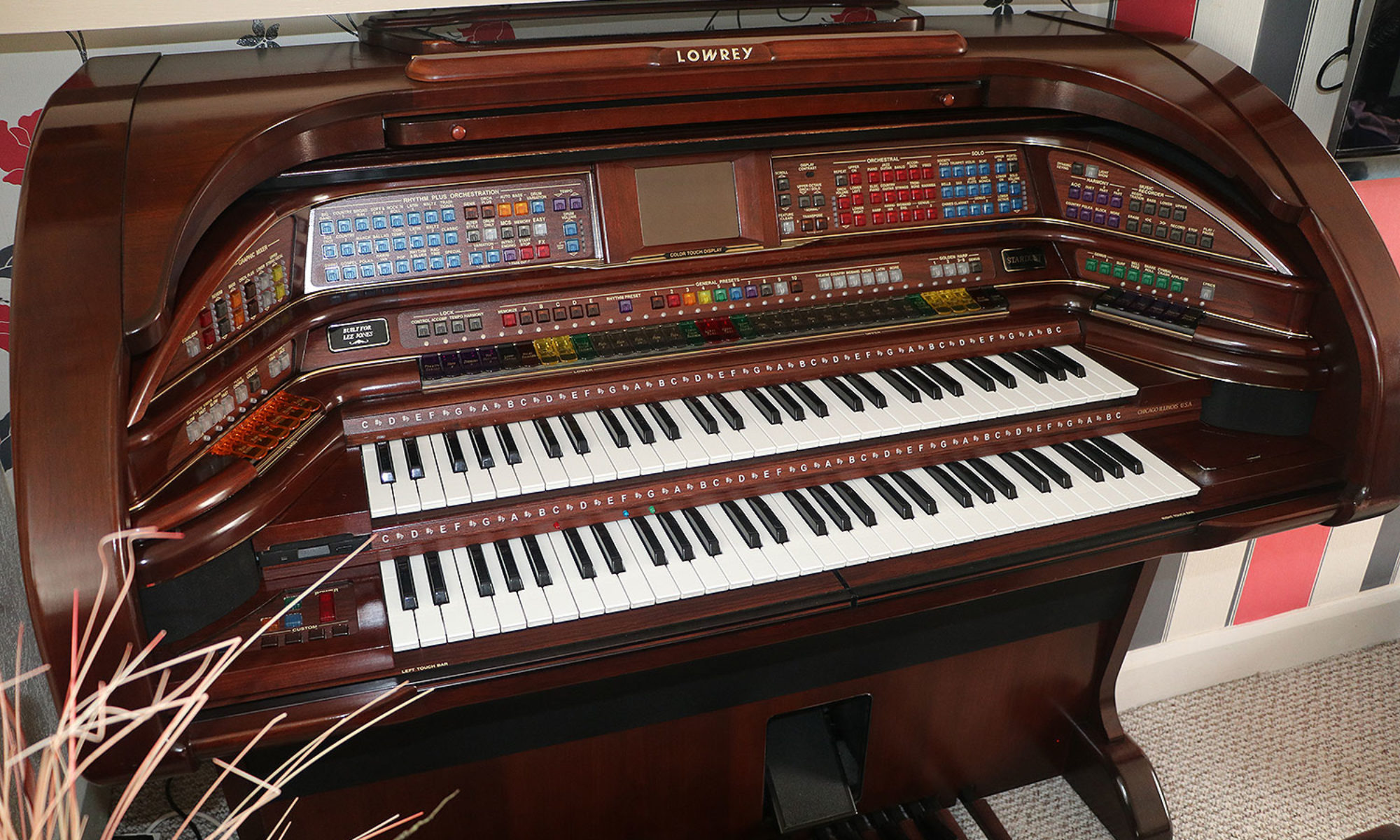
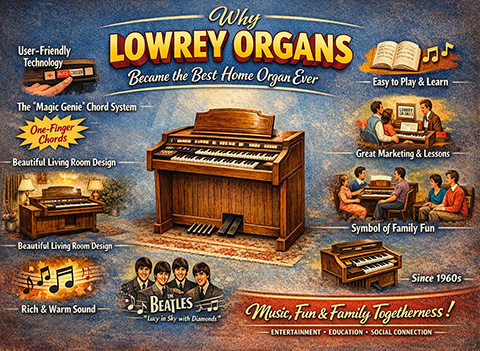
When discussing the golden age of home organs, one name consistently rises above the rest: Lowrey Organ Company. From the 1950s through the late 20th century, Lowrey established itself as the premier brand for home entertainment instruments. But what exactly made Lowrey organs stand out in such a competitive market?
The answer lies in a combination of technological innovation, user-focused design, clever marketing, and cultural timing.
1. Pioneering User-Friendly Technology
Lowrey organs weren’t necessarily the first electronic organs—but they were the first to truly prioritize ease of use for the average person.
At a time when organs could be intimidating, Lowrey introduced features that simplified playing:
- Automatic accompaniment: One finger could trigger full chords and rhythms
- Built-in rhythms: Waltz, swing, foxtrot, and more at the touch of a button
- Preset voices: Instant access to sounds like piano, strings, or brass
These features made the instrument accessible to people with little or no musical training. Instead of requiring years of study, Lowrey organs offered instant gratification, which was revolutionary for home musicians.
2. The “Magic Genie” Breakthrough
One of Lowrey’s most famous innovations was the “Magic Genie” chord system, introduced in the 1960s.
This system allowed players to:
- Play full, harmonically rich chords with a single finger
- Automatically follow chord progressions
- Sound far more advanced than their skill level
This wasn’t just a gimmick—it fundamentally changed how people interacted with music. It transformed the organ from a formal instrument into a fun, social entertainment device.
3. Designed for the Living Room
Unlike church or theater organs, Lowrey instruments were built specifically for the home.
They featured:
- Elegant wooden cabinets that matched household furniture
- Compact designs suitable for living rooms
- Built-in speakers for a full sound without extra equipment
Lowrey didn’t just sell instruments—they sold lifestyle pieces. Owning a Lowrey organ was as much about home entertainment and status as it was about music.
4. Superior Sound for Its Time
Lowrey organs developed a reputation for their rich, warm, and layered tones.
Compared to competitors:
- Their sound engines produced fuller harmonics
- The orchestral voices felt more “alive”
- The rhythm sections were more engaging and musical
This made them especially popular for:
- Easy listening
- Popular standards
- Dance music
Even professionals occasionally praised Lowrey for achieving a balance between authenticity and playability.
5. Brilliant Marketing and Education Programs
Lowrey didn’t just sell organs—they built a complete ecosystem.
Their strategy included:
- In-home demonstrations by sales representatives
- Free or subsidized lessons for buyers
- Songbooks tailored to their instruments
- Community-based music classes
This approach created a loyal customer base. Buyers weren’t left alone—they were guided into becoming confident players.
6. Perfect Timing in Post-War America
Lowrey’s rise coincided with a unique cultural moment:
- Post-World War II prosperity meant more disposable income
- Families were investing in home entertainment
- Television hadn’t yet dominated leisure time
The organ became the centerpiece of family gatherings, and Lowrey positioned itself perfectly to capitalize on this trend.
Owning a Lowrey organ symbolized:
- Middle-class success
- Cultural sophistication
- Family-oriented entertainment
7. Association with Pop Culture
Lowrey organs also found their way into popular music, most famously through The Beatles.
The distinctive sound of a Lowrey organ can be heard in songs like:
- “Lucy in the Sky with Diamonds”
- “Being for the Benefit of Mr. Kite!”
This gave the brand a cool factor that extended beyond the living room and into mainstream music culture.
8. Reliability and Longevity
Another key factor was build quality.
Lowrey organs were:
- Durable
- Mechanically reliable
- Built to last decades
Many units from the 1960s and 70s still function today, which reinforced the brand’s reputation for quality and value.
9. A Complete Musical Experience
Ultimately, Lowrey organs succeeded because they delivered something bigger than just an instrument:
They offered:
- Entertainment
- Education
- Social connection
- Creative expression
Other brands focused on musicians. Lowrey focused on people.
Conclusion
Lowrey organs became the best home organs ever not because they were the most technically complex, but because they were the most human-centered.
They removed barriers to music-making, embraced the needs of everyday users, and turned playing into an enjoyable, accessible experience. By blending innovation, design, and smart marketing, Lowrey didn’t just dominate a market—they defined an era of home music.
Even today, their legacy lives on as a reminder that the best instruments aren’t always the most advanced—they’re the ones people actually love to play.
Hi, I own a Lowrey Holliday [1991], and listeners are constantly astonished by the rich tone opening up new vistas on old tunes. This organ was headed for the rubbish tip.